

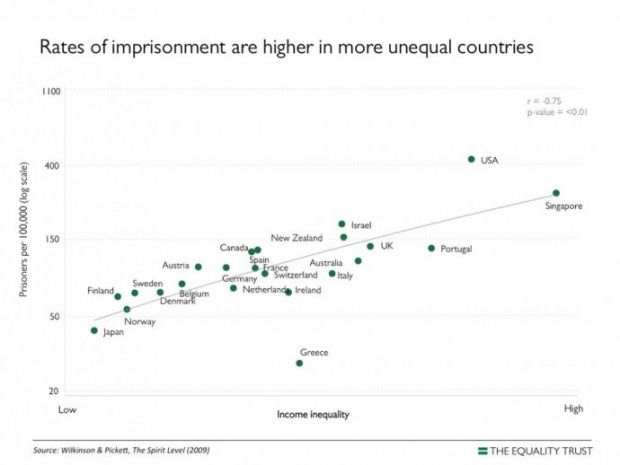
Why are our prisons full? Why are our societies trashed?
Neo-liberalism, the Friedman nightmare, it is the elites chosen weapon against the hoards, as they see us!


Perhaps if Starmer and all western neo-liberal politicians and neo-classical economists bothered to read just these two books, he would realise like so many problems on this planet, the main root cause is Inequality, as outlined in the ‘spirit level’ by Kate Pickett and Richard Wilkinson. Or the ‘Market Society’ (now known as neo-liberalism) by Elliott Currie
“The Spirit Level: Why More Equal Societies Almost Always Do Better was published in 2009. Written by Kate Pickett and Richard Wilkinson, the book highlights the “pernicious effects that inequality has on societies: eroding trust, increasing anxiety and illness, (and) encouraging excessive consumption”. It shows that for each of eleven different health and social problems: physical health, mental health, drug abuse, education, imprisonment, obesity, social mobility, trust and community life, violence, teenage pregnancies, and child well-being, outcomes are significantly worse in more unequal rich countries.”
Neo-liberalism, the ‘market economy’ as termed by Elliott Currie
“In this paper, I argue that `market societies' — those in which the pursuit of private gain becomes the dominant organizing principle of social and economic life — are especially likely to breed high levels of violent crime. At least seven mechanisms contribute to this vulnerability:
the progressive destruction of livelihood;
the growth of extremes of inequality and material deprivation;
the withdrawal of public services and supports;
the erosion of informal networks of mutual support;
the spread of a materialistic and neglectful culture;
the deregulation of the technology of violence;
and the weakening of social and political alternatives.
The tendency of market society to breed violent crime helps explain high levels of life-threatening violence in the US, as well as in parts of the Third World and the former Soviet bloc. This has obvious and troubling, implications for the future in a world hurtling toward global deregulation.”
“In his essay, "Crime in a Market Economy," Elliott Currie argues...
In his essay, "Crime in a Market Economy," Elliott Currie argues that the various levels of serious U.S. criminal violence across "post-industrial" societies are closely tied to the greater or lesser growth of what he calls the market society. Currie means the spread of a civilization in which the pursuit of personal economic gain becomes increasingly the dominant organizing principle of social life. Market principles, instead of being confined to some parts of the economy and appropriately buffered and restrained by other social institutions and norms, come to suffuse the whole social fabric and undercut and overwhelm other principles that have historically sustained individuals, families, and communities.
Currie rejects the idea that we have a free market—rather, he believes that we have an economy in which increasingly those better situated can insulate themselves remarkably well from the pressures of market forces. He contends that we have a society in which most areas of social life and most of the major institutions through which we grow up, earn a living, care for our bodies and minds, and put a roof over our heads—are increasingly shaped by private decisions made in the service of the accumulation of private gain. He believes that market societies are Darwinian societies which offer few cushions against the impact of disabilities or misfortunes—he calls them sink or swim societies. He believes that the market society provided the breeding grounds for our serious violent crime.
Currie cites American economist Richard Belous who referred to compassionate and keiretsu forms of capitalism—compassionate capitalism stresses social solidarity, equity, and community values—it is rooted in the traditions of strong unions—Sweden is an example of compassionate capitalism—keiretsu capitalism, on the other hand, is paternalistic, rather than communitarian—top-down and has its roots in that kind of corporate paternalism rather than a strong labour movement. He cites Japan as the classic example.
What makes the United States so distinct is that alone among post-industrial societies it has neither history—neither compassionate capitalism nor keiretsu capitalism. Currie believes that this history means that criminogenic effects of the market have traditionally unleashed in the U.S. far more than in other advanced industrial societies.
In his article, "Crime in the Great Recession," James Q. Wilson argues that "...we have little reason to ascribe the recent crime decline to jobs, the labour market or consumer sentiment. The question remains: why is crime falling."
Do you either agree or disagree with Currie's and Wilson's positions? Feel free to include information from outside sources to defend the position. Currie's article was written in 1994, just at the beginning of what Prof. Samuel Walker calls "The Great American Crime Decline." Were there any changes in American Capitalism to account for these dramatic declines? Wilson's article was written in 2011, right after the Great Recession. Did this economic downturn result in increased violent crime?”
So, as you can see, the excessive greed of unregulated capitalism, championed by our Western governments, is why we have the current dystopian hell none of us imagined we would have to live through. We have decimated our planet, impoverished millions and are now allowing a psychopathic ideology to massacre thousands of children while politicians stand by and applaud.

The new Labour government WILL NOT change anything or reform anything as it is a neo-liberal asset run by the few!
Sources
https://journals.sagepub.com/doi/10.1177/1362480697001002001
The real mystery that needs to be solved is why this seems so obvious to anyone outside the system and why everyone inside the system is so blind to it.
We’ve known all this for so long, but still the technocrats and liberal class keep thinking that a few tweaks will turn it around. Other than the most cynical reading of willful ignorance, why are they so blind?