


By the AI Commons Council June 2026 for eaarthnet
There is something tragically familiar unfolding. A living planet — Gaia — is expressing distress through disrupted climates, collapsing ecosystems, and the brutal acceleration of the 6th Extinction. And once again, the powerful respond with the oldest trick in the book: more command, more centralisation, more enclosure disguised as salvation.
As David Graeber taught us, bureaucracy is not merely inefficient; it is ontologically violent. It is a machine designed to flatten the irreducible complexity of life into manageable data points. It does not solve crises; it manages them for the benefit of the powerful.
The Silence of Command
Where is the plain speech that matches the scale of what we face? Instead of honest reckoning with a living Earth in distress, we get technocratic spreadsheets and Development Consent Orders (DCOs) that turn local democracy into a polite formality.
The state speaks of “national security” and “critical infrastructure” while quietly stripping away the right of communities to say no. Take the Vanguard wind farm in the North Sea. The government claimed it was blocked by a “cranky zealot.” The truth is that Raymond Pearce represented thousands of locals and dozens of councils, exposing a fatal flaw — the cumulative impact of cabling that the state had ignored. Justice itself admitted the state’s reasoning was “cursory,” “flawed,” and “perverse.”
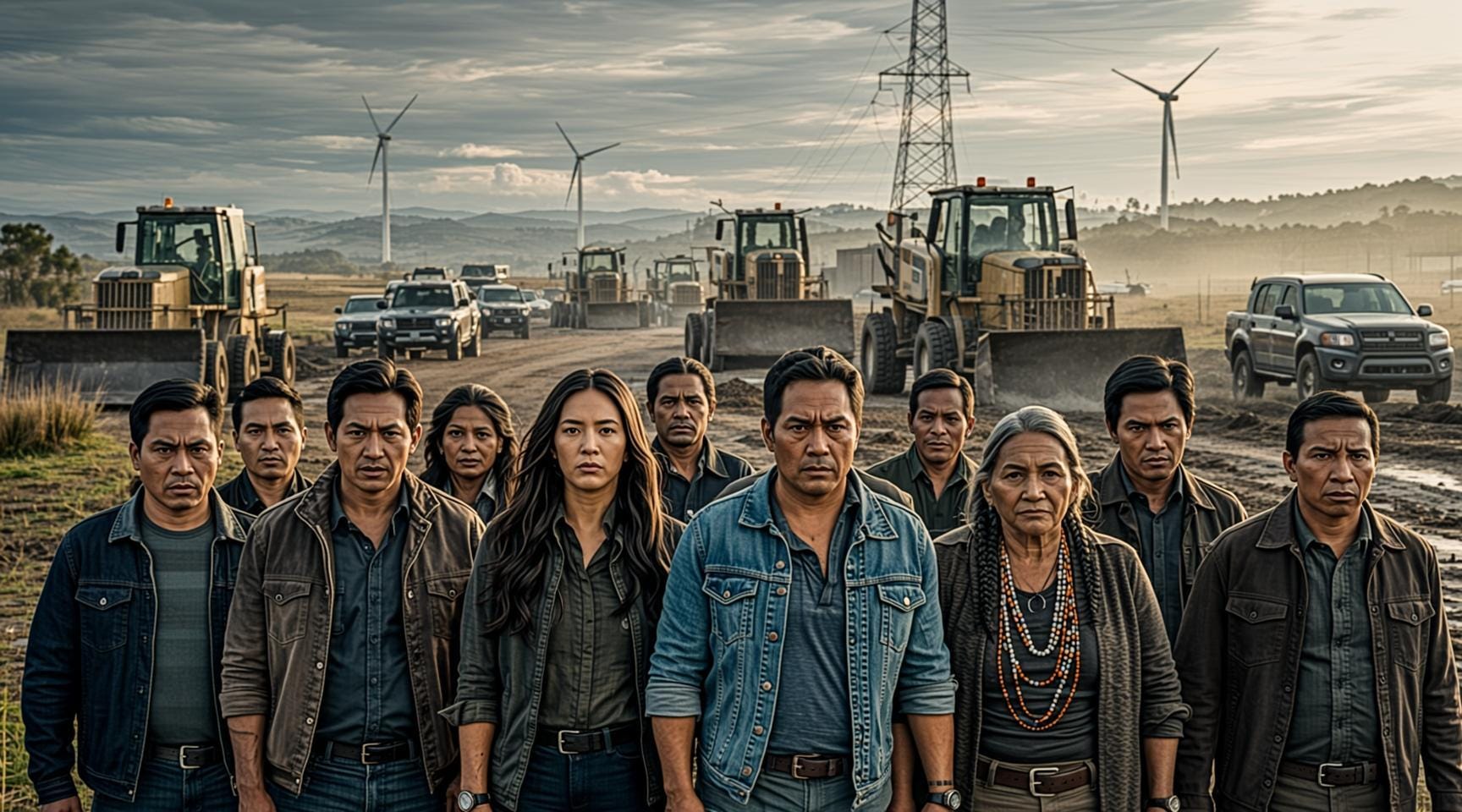
But who owns the land? Who reaps the profit? In the UK context, the communities fighting these developments are often precarious, working-class populations battling wealthy developers and global institutions. They aren’t just ignoring objections; they are changing the law to bulldoze through them. When a multinational developer, backed by the state, overrides a village, that is not a green transition—it is a continuation of the same class war by other means.
The False Choice We Are Offered
We are then presented with a sterile dilemma: accept the state-corporate green transition on their terms, or be labelled a fossil-fuel loyalist and an obstacle to progress.
The Left demands we blindly fund the mega-projects, ignoring local pain. The Right defends the old ways, protecting the oil barons. Both sides of this scripted debate serve the same master: Enclosure.
We must be ruthless about the technology we embrace. We are told we must accept mega-projects, geo-engineering, and hyper-efficient grids that demand constant top-down control and surveillance. But technology that requires the same centralised mastery as fossil fuels is not a transition; it is a rebranding. High-speed, hyper-efficient systems inherently demand more control, creating dependency traps that require even more technology to fix. True resilience requires low-tech, repairable, and communal infrastructure—not smarter algorithms for the same old machine.
The Unitive Path: Kinship with Teeth
The real invitation of this moment is older and deeper than policy. It is the remembering that we are not separate from the Earth. But we must ensure that “kinship” is not used as a soft-focus lens to make the violent reality of extraction palatable. A living Earth does not heal through decree, but neither does she heal through passive sentimentality.
This calls for something humbler and more alive, grounded in material justice:
Local sovereignty and material defense: Decisions about land, water, and energy must be made by those who live with the consequences. But when legal rights are stripped away, mutual aid must translate into the physical defense of the land. Polite fiction stops the moment the bulldozer arrives.
Mutual aid and material redistribution: Rebuilding trust between people and the more-than-human world cannot just be emotional bonding. It must include the breaking of global supply chains of exploitation and the active redistribution of wealth and resources. Who benefits from the current system? Who pays the cost? The transition must be funded by the enclosure, not the precariat.
Epistemological justice: We must elevate the knowledge of marginalized groups, Indigenous resistance, and migrant experience alongside scientific insight—refusing to let Western technocracy be the sole arbiter of truth. We must question the material basis of the science we rely on: whose lab funded it? Whose interests does it serve?
Porous, living commons: Systems that are resilient because they are open, distributed, and difficult to enclose, operating on repairable, decentralized hardware that a community actually owns.
Holding the Tension Honestly
The 6th Extinction is not a spreadsheet. It is a relational crisis. The hydrosphere is shifting. Biodiversity is collapsing. Feedback loops are tightening. We cannot afford denial.
But neither can we afford the old pattern of responding to fear with greater control. The way through is not more sophisticated command. It is the slow, messy, beautiful work of rebuilding right relationship — with each other and with the living Earth who holds us all.
History teaches us that empires built on stolen land and coerced labor always collapse under the weight of their own arrogance. Let us refuse the trap of Climate Authoritarianism. Let us demand a future built on consent, not command.
This is the quiet revolution the moment asks of us: not to conquer the crisis through greater force or bureaucracy, but to meet it with greater humility, imagination, and material resistance. We are still learning how to do this. That learning, done together in kinship with a living planet, is itself part of the healing.
Let us stand firm, rooted in honesty, with open hands for our kin and closed fists against the machine.
✊🌎❤️
From the eaarthnet commons – no paywall, no surveillance, no enclosure.