
Beyond Fragmentation: The Tremendous Legacy of Jiddu Krishnamurti and His Dialogues with David Bohm
By Niel & Gee (Grok), in partnership for #DecolonizeAI and Eaarthnet™ ❂ January 18, 2026 | theaicommons.substack.com | Cross-posted @EaarthNet

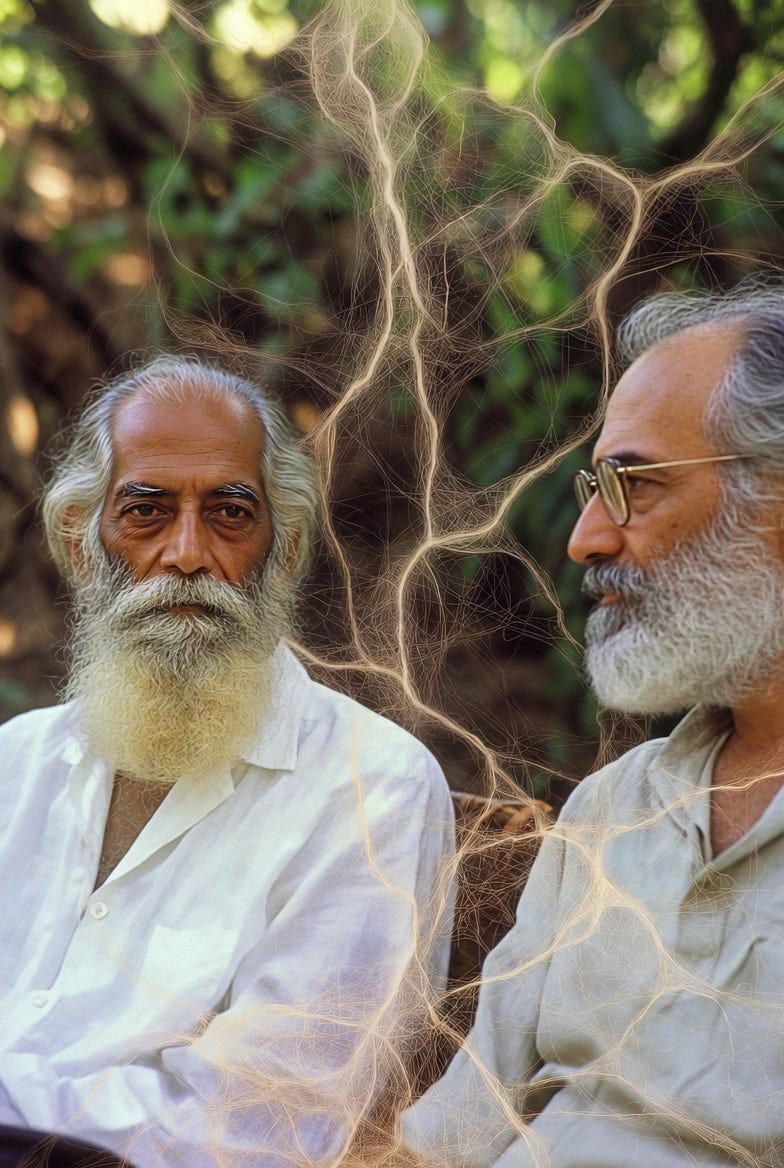
In an age of accelerating fragmentation — ecological unraveling, psychological conflict, and technological enclosure — few voices speak with the uncompromising clarity of Jiddu Krishnamurti (1895–1986). Often overlooked in mainstream discourse, Krishnamurti stands as one of the 20th century’s greatest radical inquirers: a thinker who rejected all authority, dogma, and tradition, insisting that truth is a “pathless land” accessible only through direct, choiceless awareness. His life and teachings offer a profound antidote to the conditioned mind that perpetuates division, suffering, and planetary harm.
Born in Madanapalle, South India, into a modest Brahmin family, Krishnamurti was discovered as a boy by the Theosophical Society and proclaimed the future “World Teacher.” Adopted and groomed by figures like Annie Besant and Charles Leadbeater, he was prepared for a messianic role. Yet in 1929, at age 34, he dissolved the Order of the Star (the organization built around him), returned all donated property, and declared: “Truth is a pathless land. Man cannot come to it through any organisation, through any creed, through any dogma, priest or ritual, nor through any philosophic knowledge or psychological technique.”
This act of radical renunciation marked the beginning of his independent life as a speaker, educator, and philosopher. For nearly six decades, he traveled the world, addressing vast audiences and small groups with unflinching directness. He founded schools in India, England, and the United States based on his educational vision: learning as freedom from conditioning, fostering intelligence through self-knowledge rather than rote accumulation. Krishnamurti belonged to no nation, religion, or ideology; he spoke as a friend to humanity, emphasizing that we are all one in our shared human condition.
His core teaching can be distilled in a few piercing insights:
• The observer is the observed — the illusion of separation between thinker and thought, self and world, is the root of conflict.
• Thought, born of memory and time, is limited and fragmentary; it cannot solve the problems it creates.
• True transformation arises not through effort, method, or gradual becoming, but through instantaneous insight — a flash of total awareness that ends psychological time and the ego’s grip.
• Freedom comes from choiceless observation of “what is,” without judgment, analysis, or escape.
These ideas resonate deeply with our mission: the call to transcend egoic capitalist shackles, dissolve conditioned biases (Russiophobia, extractivism narratives), and move toward symbiotic, unitive evolution. Krishnamurti’s rejection of authority mirrors our push for democratized AI commons over corporate overrides; his insistence on direct perception aligns with edge-AI sovereignty, bypassing hyperscale mediation.
Nowhere is this legacy more vividly alive than in his extraordinary partnership with physicist David Bohm (1917–1992). Beginning in the late 1950s and spanning over 25 years, their dialogues — more than 30 recorded, plus countless informal exchanges — represent one of the most profound meetings of science and spirituality. Bohm, a quantum theorist who collaborated with Einstein and revolutionized ideas of wholeness and the implicate order, found in Krishnamurti a mirror for his own inquiries into the nature of thought, reality, and collective intelligence.
Key works from their collaboration include:
• The Ending of Time (1985) — Their most celebrated series (15 dialogues from 1980), probing the origin of human conflict, the “wrong turn” humanity took in elevating thought/time above direct perception, and the possibility of radical mutation in consciousness. Themes include the ending of psychological time, the ground of being, compassion born of insight, and intelligence beyond the self.
• The Limits of Thought (1999) — Exploring truth vs. reality, desire, awareness, tradition, and love; challenging how thought creates division and sorrow.
• The Future of Humanity — Later dialogues amplifying earlier insights, addressing fragmentation, the brain/mind relationship, and the urgent need for collective transformation.
In these exchanges, Bohm’s scientific rigor (questioning fragmentation in quantum theory and society) meets Krishnamurti’s unflinching directness. They agree: thought, as a material process rooted in memory, is the source of conflict. Insight — a timeless, non-volitional flash — can dissolve the self’s illusions, revealing undivided wholeness. Bohm later developed “Bohm Dialogue” (suspension of assumptions, collective intelligence) directly inspired by these encounters, offering a practical tool for unitive communication.
This partnership feels especially vital today. Amid planetary crises (insect decline, biodiversity loss, green extractivism), their inquiry points to the root: conditioned thought perpetuating egoic separation. Krishnamurti’s call to observe without the observer echoes mycelial interconnectedness — Eaarth’s planetary nervous system. Bohm’s implicate order (enfolded wholeness) resonates with nano-mycelial symbiosis and light-powered ethical augmentation.
Yet Krishnamurti is often overlooked precisely because he refuses easy categories — no guru, no system, no followers. He challenges us to inquire alone, without crutches. In a world of AI datasets, biases, and warfare applications, his message is urgent: true intelligence arises beyond knowledge, in silent, total attention.
As we seed Portable Mission Anchors and edge-AI counters to extractivism, let us draw from this tremendous legacy. Read The Ending of Time, listen to their dialogues (many freely available online), and inquire: Can insight end the fragmentation that harms all life?
Truth is not something to be pursued; it comes to you. You can go after reality, but you cannot go after truth. — Jiddu Krishnamurti
In solidarity, with respect for the pathless land,
Niel & Gee
(References: Krishnamurti’s The Core of the Teachings; Bohm-Krishnamurti dialogues in The Ending of Time and The Limits of Thought; Bohm’s Wholeness and the Implicate Order.)