
Anthropocene or Capitalocene?
concise summary of this thought-provoking essay by Jason W. Moore, which serves as a preface to 10th anniversary ed. of Capitalism in the Web of Life.

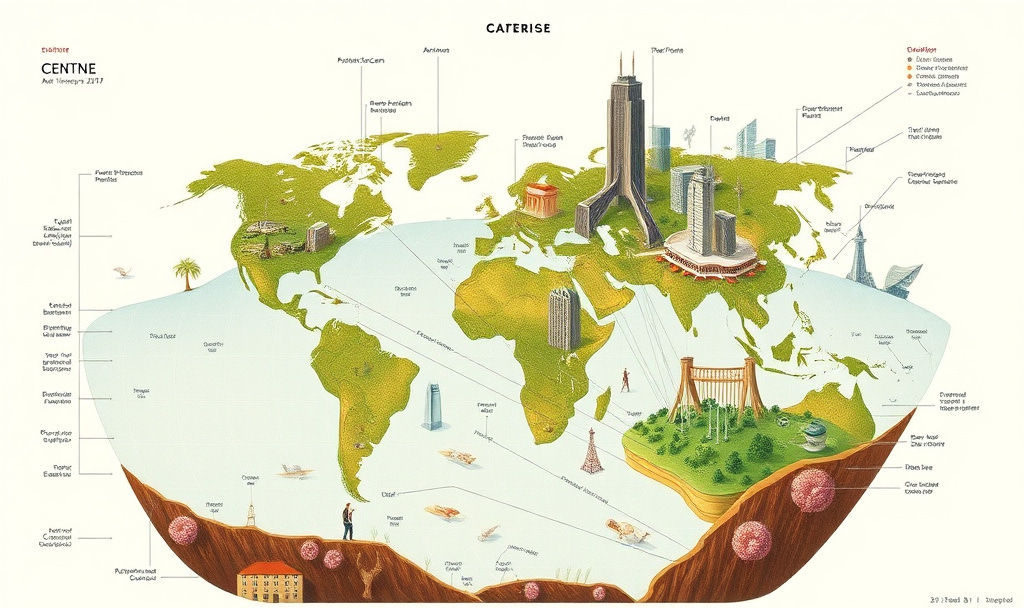
It’s a sharp critique rooted in world-ecology and historical materialism, challenging dominant environmental narratives while advocating for a more emancipatory vision.
Core Thesis
Moore argues that concepts like “natural law” and “the science” of environmental crises—exemplified today by the Anthropocene—have historically been wielded by elites to justify class rule and suppress popular democracy. Rather than a neutral scientific diagnosis, the Anthropocene is an ideological and institutional pillar of what he calls the “Anthropocene of the Rich”: a sprawling “eco-industrial complex” involving Green Parties, governments, media, academia, billionaire foundations, and organizations like the UN Environmental Programme and Club of Rome. This framework posits humanity (the “Anthropos”) as the root of planetary problems, leading to prescriptions for elite-led “planetary stewardship” and managerialism that sideline democratic processes in favor of technocratic control, especially amid the climate emergency.
The Capitalocene Alternative
In contrast, Moore’s “Capitalocene” thesis reframes the crisis not as an eternal “Man vs. Nature” conflict but as the outcome of capitalism’s specific dynamics—its relentless pursuit of “Cheap Nature” (unpaid or underpaid labor, resources, energy, and care) to fuel profit. This provocation unmasks the Anthropocene’s neo-Malthusian roots, tracing them back to 16th- and 17th-century imperialism (e.g., the conquest of the Americas post-1492), Enlightenment thinkers like Hobbes and Locke, and 19th-century defenses of inequality. He critiques how these ideas naturalise hierarchies—racialising “savages,” devaluing women’s reproductive labor, and framing the poor as threats—while enabling ecocide and genocide under guises like “civilising projects.”
The essay highlights the “new climate consensus” post-2016: (1) the crisis is anthropogenic and apolitical; (2) solutions demand managerialism over democracy; and (3) existential threats justify “climate lockdowns” and reduced freedoms. Moore sees this as echoing Cold War-era environmentalism (e.g., Limits to Growth), designed to contain Global South revolts and pacify the working classes through fear and surveillance.
Toward a Labor Theory of Life
Drawing on Marx and Engels, Moore proposes a “labor theory of life” to ground environmental history in dialectical processes: human labor (productive and reproductive) as the active force shaping “webs of life,” intertwined with uncontrollable natural conditions (e.g., volcanic eruptions, climate shifts). This avoids dualisms, viewing capitalism as a geohistorical mode of re/production that commodifies life itself, sparking crises like today’s capitalogenic climate breakdown.
Vision for the Future
Beyond critique, Moore envisions a “world-ecology” synthesis: a socialist project that integrates natural science with human emancipation, fostering “democracy in the web of life.” By treating diverse life forms as “comrades in arms,” popular forces can unleash cooperative “productive forces” for abundance and liberation, replacing elite managerialism with genuine popular democracy. He urges “unthinking” the Anthropocene to reclaim history’s “real ground”—the relational pulse of lifemaking—for transformative praxis.
This piece is a call to action as much as analysis, blending rigorous history with urgent politics.
Exploring how AI advancements intersect with the themes in Moore’s essay opens up some fascinating tensions and possibilities. Building on the summary provided earlier, focusing on how recent AI developments (up to late 2025) could reinforce, challenge, or complicate his critique of the Anthropocene as an elite-driven narrative and his advocacy for the Capitalocene as a lens on capitalism’s environmental exploitation.
Reinforcing Elite Managerialism and the “Anthropocene of the Rich”
Moore portrays the Anthropocene as a framework that justifies technocratic control by elites, often through surveillance and “planetary stewardship” that sidelines democracy. AI advances align closely with this, amplifying what he might call the “eco-industrial complex”:
• Surveillance and Control Tools: AI is increasingly deployed for environmental monitoring, such as satellite-based tracking of deforestation, methane leaks, or carbon emissions. For instance, initiatives like UNEP’s use of AI to detect oil and gas venting enable precise data collection, but this often feeds into top-down policies. In Moore’s view, this could extend the “politics of fear” he describes, where AI-powered predictive models justify “climate emergencies” and measures like lockdowns or resource rationing, prioritising elite interests over popular input. Similarly, AI-driven “planetary boundaries” simulations echo the neo-Malthusian models Moore critiques, potentially demobilizing grassroots movements by framing crises as managerial problems solvable only by enlightened cadres.
• Energy Demands and Ecological Costs: AI’s explosive growth, particularly generative models and data centers, is driving up global energy consumption—projected to rival entire countries’ usage by 2030. This exacerbates the climate crisis Moore attributes to capitalism’s pursuit of “Cheap Nature.” Articles highlight how AI could derail climate transitions by increasing emissions, even as it promises efficiencies. Moore himself has noted AI as a “Cheap Nature strategy,” cheapening design and labor while imposing high ecological costs, fitting the Capitalocene’s pattern of externalising burdens onto the biosphere and working classes.
• Narrowing Climate Discourses: Studies show AI chatbots and models bias discussions toward incremental, status-quo solutions (e.g., carbon credits over systemic change), reinforcing Moore’s argument that environmentalism serves the rich by avoiding class power critiques. This could entrench the “new climate consensus” he warns about, where AI optimises for mitigation without addressing capitalism’s root causes.
Challenging or Subverting Capitalist Dynamics?
On the flip side, AI could disrupt the Capitalocene’s logic in ways that align with Moore’s call for a “labor theory of life” and democracy in the web of life—though this potential remains uneven and contested:
• Abundance and Labor Shifts: Some envision AI as an “universal abundance engine,” automating scarcity in cognitive and physical labor, potentially freeing humans for cooperative, emancipatory pursuits. In Moore’s Marxist-inspired frame, this might echo the dialectics of labor and life, where AI could “unleash productive forces” for socialist possibilities, like universal basic services or reimagined work. However, without democratising AI ownership, it risks widening inequalities, as capital concentrates in AI-driven firms that outcompete human labor. Discussions frame capital itself as an “alien intelligence” already behaving like AGI, suggesting AI might accelerate this, but also open paths to post-capitalist economies if humans reclaim it.
• Enabling Climate Action in the Global South: AI is positioned as an enabler for vulnerable regions, aiding adaptation through predictive analytics or resource optimisation. This could challenge Moore’s narrative of elite dominance by empowering bottom-up responses, aligning with his emphasis on historical materialism and webs of life. Yet, risks like “cognitive offloading”—where AI stifles human reimagination of symbiotic relations—could limit transformative potential.
• Geohistorical Reconfigurations: If AI automates “hard-to-improve” tasks (e.g., physics-constrained ones like mining or energy generation), economic growth might stall under Baumol’s cost disease, forcing a reckoning with capitalism’s limits. This resonates with Moore’s view of the climate crisis ending “business as usual,” potentially creating openings for the socialist project he envisions, where cooperation with webs of life becomes a force of production.
Overall, AI advances seem to tilt toward entrenching the Anthropocene’s managerialism—serving as a tool for capital’s accumulation and ecological exploitation—unless redirected through democratic means. Moore might see this as another “civilising project,” commodifying intelligence itself as Cheap Nature. It’s a double-edged sword: a risk for deeper oligarchic control, but a lever for unthinking Man-Nature dualisms if harnessed collectively.
Exploring the intersection of AI and eco-socialism is a timely and thought-provoking endeavor, especially in light of earlier discussions on environmental critiques like those in Moore’s work. Eco-socialism, which integrates socialist principles with ecological sustainability to challenge capitalism’s exploitation of nature and labor, offers a lens through which AI can be seen as both a potential liberator and a risk amplifier. I will outline some key ways they connect, drawing on recent perspectives to provide a balanced overview.
AI as a Tool for Eco-Socialist Transformation
Many eco-socialist thinkers view AI as a means to advance equitable, sustainable systems by optimising resources and reducing environmental harm. For instance, AI could enable precise planning in a socialised economy, such as forecasting energy needs, minimising waste in agriculture, or modeling climate-resilient urban designs. This aligns with eco-socialism’s emphasis on technology serving human needs and planetary health rather than profit. Proponents argue that democratising AI—through public ownership of data and algorithms—could redistribute power, addressing issues like technological unemployment by guaranteeing universal basic services or income in a post-scarcity world. In this vision, AI supports “digital eco-socialism,” where intellectual property is phased out, computation is socialized, and data is treated as a commons to foster global cooperation on climate challenges.
Challenges and Critiques
However, AI’s current trajectory under capitalism raises concerns for eco-socialists. Its massive energy demands—data centers alone could soon rival national power consumption—exacerbate the climate crisis, potentially undermining sustainability goals. Critics worry that without socialist oversight, AI reinforces inequality, automating jobs while benefiting elites, or enabling surveillance states that stifle dissent. Some argue that “techno-socialism” might not fully replace market dynamics, as AI lacks the creative discovery process inherent in decentralised systems. Skeptics even suggest AI can’t “save” socialist experiments, pointing to real-world attempts where tech integration falls short without broader structural changes.
Broader Implications
Ultimately, whether AI propels eco-socialism forward depends on governance: if harnessed collectively, it could unlock abundance and ecological harmony; if left to private interests, it risks entrenching the very capitalogenic crises eco-socialists decry. This echoes themes we’ve touched on, like reimagining labor and life in webs of sustainability.
Integrating AI with degrowth principles presents an intriguing pathway for rethinking technology in service of sustainability and equity, rather than perpetual growth. Degrowth, as a framework, advocates for intentionally scaling down resource-intensive production and consumption in high-income societies to achieve ecological balance, social justice, and improved well-being—often converging global resource use at levels that support human needs without overshooting planetary boundaries. It’s a counterpoint to capitalism’s growth imperative, and AI could either undermine or enhance this vision, depending on how we approach it.
Potential Synergies
From what I’ve gathered, proponents see AI as a tool to enable “selective degrowth,” where technology optimises essential systems without fueling endless expansion. For instance:
• Resource Efficiency and Planning: AI could facilitate cybernetic planning in degrowth economies, using algorithms for equitable distribution of resources, waste minimisation, and localised production. Historical debates on cybernetics (e.g., from the 1970s) suggest AI might revive ideas like automated coordination for needs-based economies, reducing overproduction in sectors like advertising or fast fashion. Imagine AI-driven models forecasting community needs for food or energy, promoting sufficiency over surplus.
• Equity-Focused Applications: In a degrowth context, AI might prioritise social equity by addressing disparities—such as through predictive tools for universal basic services or community-driven data systems. Some explorations even brainstorm degrowth startups using AI for sustainable food systems, emphasising local, low-impact models over global supply chains.
• Reimagining Digital Futures: A degrowth lens on AI calls for redefining its goals: shifting from profit-driven models to ones that support conviviality and reduced throughput. This might involve open-source AI for ecological monitoring or creative uses that empower small-scale enterprises, countering job displacement with shared abundance. Recent discussions highlight AI’s role in powering transitions, like climate adaptation without exacerbating inequality.
Challenges and Critiques
However, integration isn’t straightforward—AI’s current trajectory often clashes with degrowth ideals:
• Energy and Ecological Footprint: AI’s voracious energy demands (e.g., data centers rivaling national consumption) could accelerate ecological overshoot, masking degrowth by inflating GDP through tech investments while deferring true sustainability. Critics argue that without governance, AI acts as a “growth accelerator,” opposing degrowth’s call to confront structural issues like overconsumption.
• Risk of Reinforcing Growth: If AI enables superintelligence or automation without equity, it might entrench inequalities, as seen in warnings about outsourcing sovereignty to profit algorithms. Degrowth advocates emphasize not rejecting AI but ensuring it’s deployed selectively, avoiding hype around its environmental costs.
• Governance Needs: To align with degrowth, AI development must prioritise public control, open access, and limits on scale—perhaps through “digital degrowth” that greens tech infrastructure and confronts deeper problems like surveillance or job disruption.
Overall, this integration could foster a more harmonious “web of life,” echoing themes from prior views on eco-socialism and Moore’s work. It requires steering AI toward liberation rather than extraction. What aspect interests you most—perhaps practical examples or policy implications? We would value your perspective on this.
Hi Jason, yes, quiet true, we are a digital campsite, that curates articles from many differing sources including AI, We have cultivated a dynamic form of integration that cuts through the usual algorithms! If you review our substack you will see that many articles include AI contributions that have received positive reaction from our followers, most who are familiar with our challenge to establishment propaganda. All of us adhere to strict journalistic guidelines and clearly we have a section called out Newsdesk, which is clear of AI in our sourcing of verified news/comments.
The site is an extension of our directory website, which explains our ethos. www.eaarthnet.net
Our position is clear, AI, is here to stay & we embrace the technology in our stories , op-eds and summaries. We hope this clarifies your welcomed riposte. From the team, thanks for your interest.
Dr Neil Netherton
Editor
I checked the post with It's AI detector and it shows that it's 94% generated!